
TL;DR
- On November 16, researchers disclosed they took over the publisher account behind an AI model with nearly 13 million monthly downloads by registering one lapsed web domain. No tampered model was released to users.
- On November 17, two malicious versions of an open-source AI package were published to PyPI. The software kept working while hidden code collected secrets.
- Protect your AI supply chain: check the components that come in, keep testing as AI runs, and turn findings into stronger controls.
The contaminated ingredient
Your team ran a routine software update. Nothing broke, and every test passed.
Now picture a busy restaurant. Every plate looks right, until a supplier calls to say the salt delivered this morning wasn’t salt.
By now, it is on every table in the dining room. That is what an AI supply chain attack looks like, and this week the news showed two ways it can start.
How AI gets built today
Your AI supply chain is everything your AI is made of. Think of it as a restaurant kitchen. You write the recipe. The ingredients come from suppliers.
Those ingredients are open-source code packages (ready-made bundles of code), pre-trained models (the trained files that produce an AI’s answers), datasets, and plug-ins that let AI agents take actions. These come from public repositories like PyPI for Python code and Hugging Face for models.
Reusing these parts is why teams can build and ship quickly. The trade-off is trust: you rely on every supplier, and they rely on theirs, so one bad ingredient can reach every dish.
What happened this week
Here are two stories from the past week, each reported by at least two outlets.
A trusted AI package was hijacked
What happened? On November 17, two malicious versions of agent-framework, the Python package for Microsoft Agent Framework, were published to PyPI: 1.26.1 and soon after 1.26.2. This package averages roughly 190,000 monthly downloads. Multiple reports say the new malicious versions still did their normal job, so AI agents using them kept running. Each time they started, the code also grabbed secrets, such as cloud and developer credentials for Azure, Amazon Web Services (AWS), GitHub, Docker, Hugging Face, and OpenAI, and sent them to an outside web address. See GitHub Advisory for more details.
Who is affected? Anyone whose builds installed agent-framework version 1.26.1 or 1.26.2 is exposed. BleepingComputer reports that the second malicious version appeared about two and a half minutes after the first.
What should you do? At this time, it is unclear how the attacker got in. Updates have been pushed, so agent-framework version 1.26.0 is the safe release. All developers should do three things: rebuild from a clean environment on it, replace their credentials that may have been exposed, and check outbound network logs for sensitive data capture and transfer.
Researchers took over the account behind a popular AI voice model
What happened? Kokoro is an open text-to-speech model. Over the weekend before November 17, a research team led by Alon Hertz registered hexgrad.com, a web domain that had lapsed. Kokoro is an open text-to-speech model. Kokoro’s public notes listed an email address on that domain, so the team reset the password on the publisher’s Hugging Face account. They then altered the model’s weights (the numbers that hold what it has learned) in 87 seconds on a gaming graphics card. See BleepingComputer and Tech Times for more details.
Who is affected? Kokoro has nearly 13 million monthly downloads on Hugging Face, by the site’s own counter. In the team’s test, the changed model read out different words than it was given. They ran it only on their own hardware and uploaded nothing, and neither report describes a tampered release reaching users.
What should you do? As of now, Hugging Face has not responded to the researchers or media. If you are using this model, check your systems and apps carefully. This is a reminder to check who controls the publisher accounts behind the models you use.
Why this matters to you
Every organization that is building AI relies on a supply chain of packages, models, skills, and third-party components. A compromised component or publisher account can bring risk directly into your AI applications and workflows. No matter how big or small an organization is, or how sophisticated its security program may be, protecting the supply chain can be a complex challenge in the AI ecosystem with heavy use of open source and dozens of new component types.
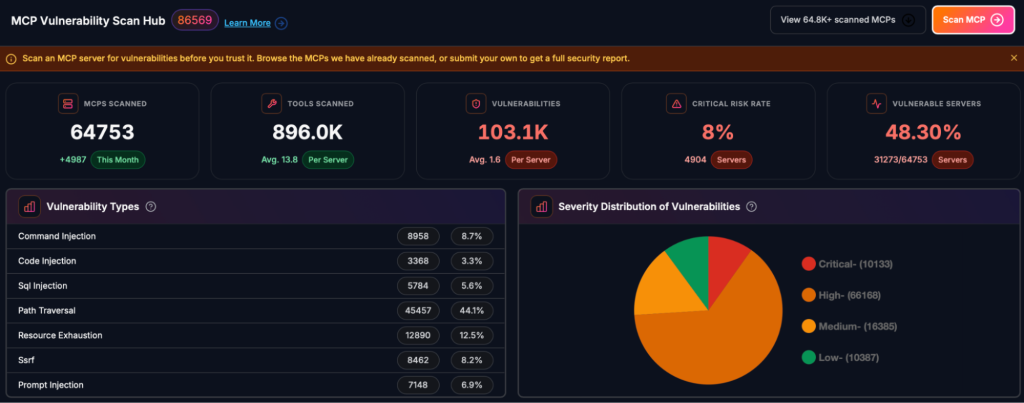
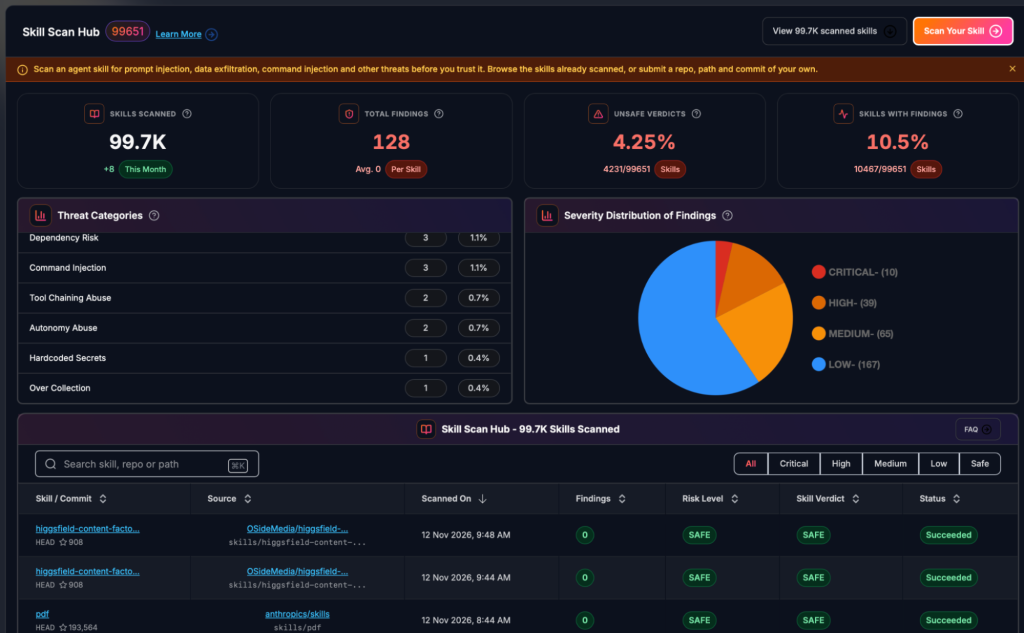
Enkrypt AI by Anaconda’s scanning benchmarks give a sense of the scale. As of November 11, 48% of the 64,000+ servers it scanned for the Model Context Protocol (MCP) were affected by vulnerabilities. This shows that nearly half the MCP servers scanned are at risk. As of November 12, 10.5% of the more than 99,600 skills it scanned, the packaged instructions that teach an agent a task, had findings, and 4.25% received an unsafe verdict. You can browse the full scan data, or submit an MCP server or skill of your own to scan before you trust it, in the Enkrypt AI scan hub.
This is why AI supply chain security is so critical today. Treat every new MCP server or skill the way you treat a new package: check it before it reaches production.
Here is how a bad ingredient reaches the business.
- Data exposure. Cloud keys in the wrong hands open your data without anyone breaking into your own systems.
- Compliance. Auditors can ask what is in your software and who approved it. If you cannot say who published the model you downloaded, you cannot show where it came from.
- Downtime. Containing a malicious component can mean pausing deployments, restoring trusted versions, and replacing exposed credentials, disrupting pipelines and business operations.
- Trust. Customers are unlikely to care which supplier failed, because your name is on the software.
Notice that each story hurts your organization in a different way. The first puts your secrets and data at risk of theft. The second could change what your AI says and does with potentially dangerous results.
How to strengthen your AI supply chain
In both stories, the risk came through a source that people trusted by default.
Good kitchens do not taste every dish at the end. They check ingredients at the door, keep a record of where each one came from, and when something is wrong, they make a change so it is less likely to happen again.
Anaconda has provided trusted Python packages for more than 15 years, and every package in our channels is vetted before it reaches your environment. Anaconda supports more than 50 million users and 1 million organizations globally, and our data shows 7.2 billion downloads of vetted packages from Anaconda channels over the past 12 months. Building on AI supply chain security, Enkrypt AI by Anaconda provides closed-loop AI safety that helps teams protect the full AI lifecycle.
Five steps protect your AI Dev Factory:
- use only trusted sources or scan what comes in
- protect the AI coding assistants
- test before launch
- defend your AI while it runs
- keep the evidence auditors ask for
What you learn in production feeds the next round of coding and testing.
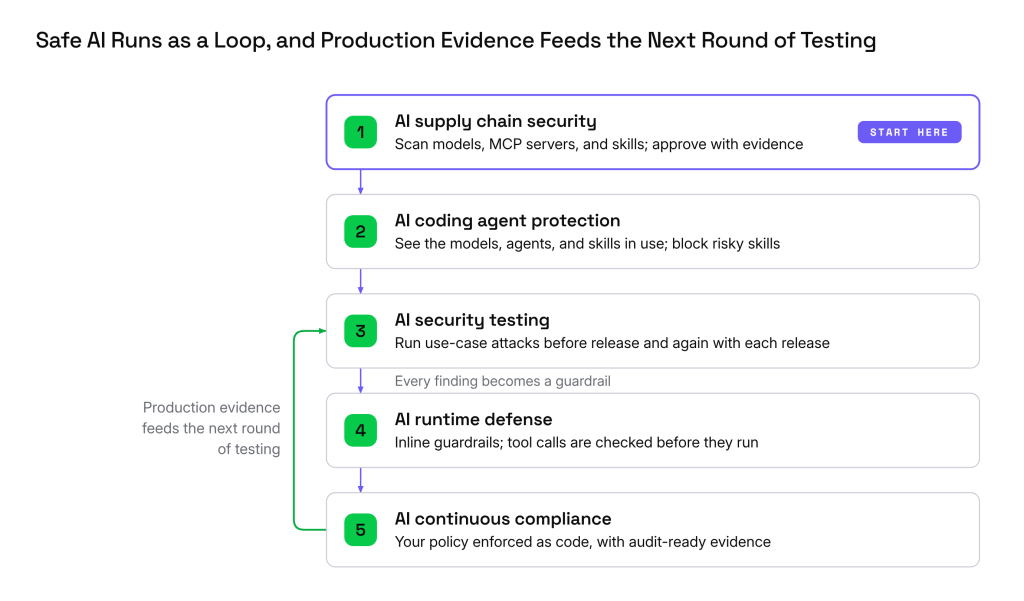
The five-step approach enables continuous feedback and action across the AI lifecycle.
Catching a bad package or model at the door is easier than cleaning up after it. Responding quickly to new issues is critical to maintaining pipeline speed.
Five questions to ask about your AI supply chain today
Start with these five questions:
- Can we list every package, model, skill, MCP server, dataset, and plug-in our AI uses, and who publishes each one?
- Do we lock each supply chain component to an exact version we have checked, or does a new release flow straight into production?
- If a supplier’s account were taken over tomorrow, how would we find out?
- Which secrets could an AI package reach the moment it starts, and how fast could we replace them?
- When we find a problem once, does it become a rule that applies across our projects?
Your next step
Pick one question and answer it this week. If an answer surprises you, that is useful to know.
We think safe AI starts at the door and stays safe when what you learn goes back into the rules for what you allow. If you want a second set of eyes on your answers, we are glad to help. Learn more about AI Artifacts and Enkrypt AI by Anaconda.
Frequently asked questions
What is an AI supply chain?
It is everything your AI is built from: code packages, pre-trained models, datasets, and the plug-ins and tools AI agents use. If you did not write it yourself, it is part of your supply chain.
What is an AI supply chain attack?
An attacker tampers with something your AI depends on, or takes over the account of the person who publishes it. The harm then arrives through a source you already trust.
Are packages on PyPI vetted for safety?
PyPI is the main public repository for Python packages, but availability there does not mean a package has been vetted or approved for enterprise use. Choose a trusted, vetted source like Anaconda. Verify provenance, scan for malicious code and vulnerabilities, and use reviewed versions, even when a package comes from a familiar publisher.
Did anyone receive a tampered Kokoro model?
Neither report describes a tampered release reaching users. The researchers changed the model on their own hardware and uploaded nothing. What they showed is that a lapsed domain was enough to reset the publisher’s password.
What should we do if we installed an affected package version?
Check whether your builds installed agent-framework version 1.26.1 or 1.26.2. If they did, take action to rebuild on 1.26.0, replace credentials that may have been exposed, and check outbound network logs.
Should we stop using open-source packages and public models?
No. Shared parts help teams move quickly. Check what you pull in, keep a record of where it came from, and turn every finding into a rule.
Where should we start?
Start with question 1 above: can you list every package, model, dataset, and plug-in your AI uses, and who publishes each one?